
No Canadian political and economic issue is as contentious, persistent, and long-running as the struggle between free trade and protection. A concise account of that issue from 1840 to the 1988 Canada-U.S. Free Trade Agreement provides essential historical background to the impending high-stakes renegotiation of NAFTA with the erratic Trump administration. The record clearly […]
Category: Economic history

Wild speculation and wasted energy marred Turner Valley, British Empire’s biggest oilfield
Epic oil In the foothills of Alberta, some 20 miles southwest of Calgary, lies Canada’s first big oilfield, the largest in what was once the British Empire, and among the largest in North America. It took 22 years to reveal the full extent of the energy stored in the Turner Valley oilfield. Most of it was […]

How Canada created the oil industry
Epic oil In 1854, Abraham Gesner laid the foundation of the oil industry when he built the first of some U.S. 70 plants that used coal to refine a lamp fuel he called kerosene, a.k.a. coal oil. In Britain, James Young had earlier started distilling a lubricating and solvent from coal. In 1856, two years after […]
You could be jailed for just talking about the Great Uranium Cartel
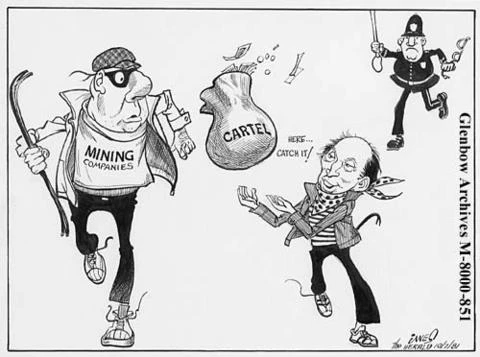
In the 1970s, continued nuclear power development was still seen by many as essential to the energy needs of an increasing, and increasingly affluent, world population. But supplies of uranium fuel were threatened by a U.S. embargo that compelled U.S. power utilities to use only U.S. uranium. The embargo depressed prices from other sources, […]

SS Manhattan signals an open Northwest Passage
All photos by author As the ice continues to shrink, the 2017 sailing season could see a record number of vessels transiting the fabled Canadian Northwest Passage. The first vessel has already left port. An ancient resuscitated icebreaker is on a 23,000-kilometre, 150-day voyage from Toronto to Victoria to help mark Canada’s 150th birthday. A giant […]

Why gentlemen prefer bonds: the 1929 stock market crash
“Gentlemen prefer bonds,” said Andrew Mellon (1855-1937), wealthy American financier, banker, and U.S. Treasury Secretary. Commons shares, or stock, were considered too speculative for gentlemen; best left to disreputable speculators. Had more investors heeded Mellon’s advice, the horrendous stock market crash of October 1929, which ushered in the Great Depression of the 1930s, would likely have […]

Flour sack clothes fashionable in Great Depression
“Ask for Flour Sack to Use for Clothing For Farmer’s Family,” said the headline in the Regina Leader Post, January 5, 1925, in an appeal to help a distressed Saskatchewan farm family. “Three successive crops dried up, hailed out and burned by fire—children take turns to wear one set of clothes.” Sack clothing was popular […]
Inflation soars after First World War
The weekly food bill for Canadian families averaged $16.48 in July 1920, Canadian Press reported, October 1, 1920. Food costs had more than doubled from $7.75 per week in December 1913, thanks to rapid inflation induced by the First World War. The average family budget in July totalled $40.76 per week, according to data from […]
New Canadians arrive by the shipload
“Seventeen special trains from Halifax and Saint John are due in Montreal” Saturday and Sunday, carrying 6,000 immigrants,” the Halifax Herald reported April 2, 1910. More than 12,000 arrived during the week. It has been “the biggest week in the immigration line that Canada has had for a good many years,” says the Herald. Most […]
The stink of dirty money
Dirty money was once more than a metaphor. It had a horrible stench, according to this letter published in the London, Ontario Advertiser, April 4, 1902. An open letter to the Hon. W.S. Fielding, minister of finance, and to all the general managers of the Canadian banks: Gentlemen — Are you willing, by a single […]